
Top 20 Benefits of Play-Based Learning for Preschool Growth
The early years of a child’s life shape how they think, communicate, and connect with the world. Understanding the benefits of play based learning helps parents and educators support development in ways that feel natural and joyful. Instead of rigid instruction, children explore, experiment, and imagine, building critical skills through hands-on experiences.
The benefits of play-based learning go beyond enjoyment to support development. Structured play strengthens language, emotional intelligence, problem-solving, and physical coordination. In preschool settings, learning through play allows children to develop confidence while staying engaged. When growth feels like discovery instead of pressure, children thrive academically and socially.

Key Features
- Play-based learning brings three advantages which include cognitive development and emotional growth and social development.
- Play supports natural curiosity and intrinsic motivation.Through group work children acquire their communication abilities.
- Through imaginative exploration students become better at solving problems.
- Hands-on activities help people develop their physical coordination skills.
- Role-play together with peer observation helps people develop their ability to control their emotions.
- Preschoolers build confidence when learning feels joyful.
- Play helps children develop their ability to make choices and their ability to work independently.
- Children develop their basic literacy and mathematics abilities through natural learning processes.
- Students who start their education through playful activities achieve better academic performance in the future.
What Is Play-Based Learning in Preschool Education
In preschool education, play-based learning enables children to learn through their process of exploration and imaginative play along with their ability to interact with others. Teachers set up spaces which include blocks and art supplies and areas for dramatic play and sensory activities and games that require teamwork. The materials enable children to test their ideas and find solutions through their questioning process. Preschoolers acquire knowledge through active participation instead of learning through rote memorization.
The method helps preschoolers develop because it corresponds with their natural developmental patterns. Through guided play, they strengthen language skills, emotional awareness, social cooperation, and motor abilities. Teachers watch students progress while they ask students open-ended questions and provide extra learning opportunities. The result is balanced development that feels engaging rather than forced. The advantages of play-based learning develop when children develop self-confidence and independence and develop a lifelong passion for learning which extends beyond their preschool years.
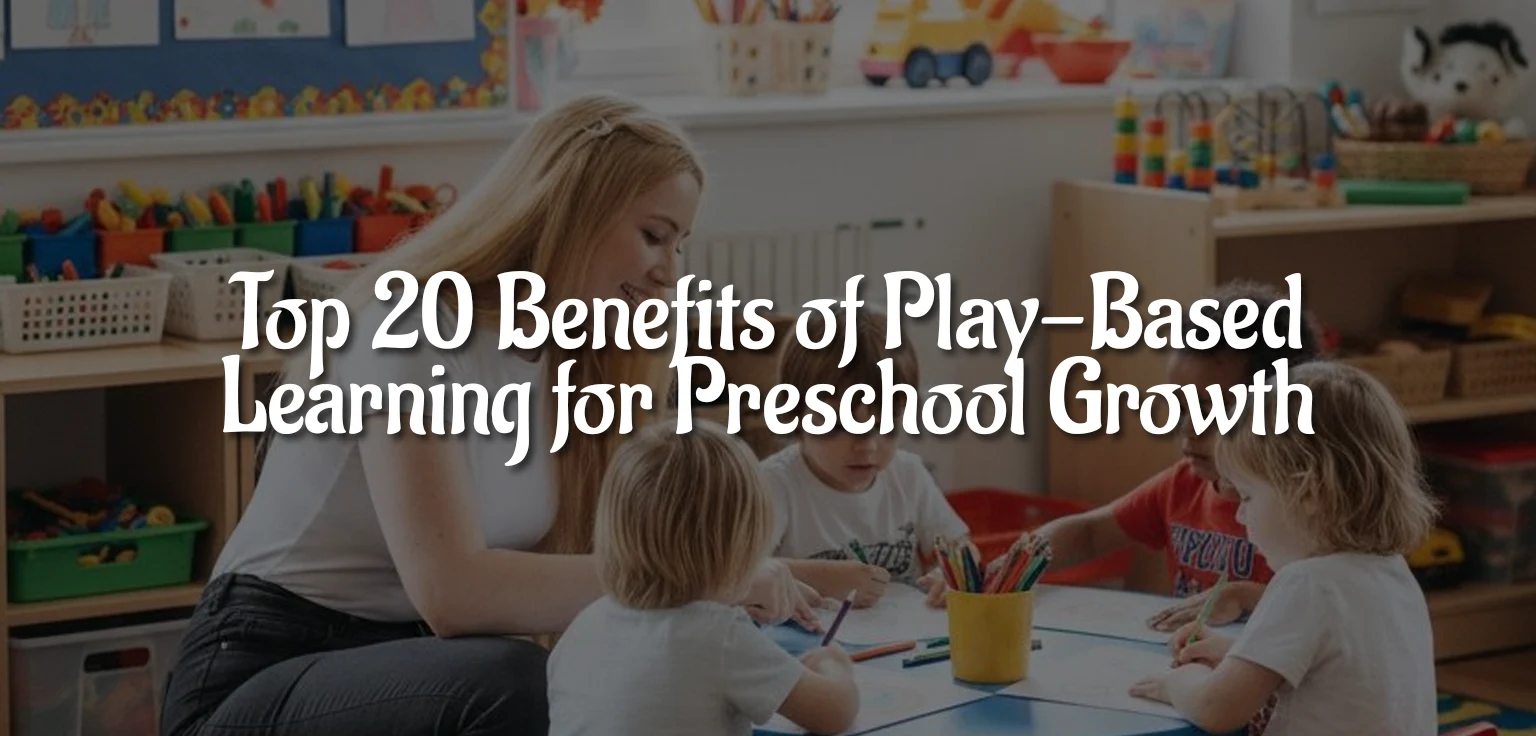
Top 20 Benefits of Play-Based Learning for Preschool Growth
According to a preschool research summary, the Top 5 benefits of play-based learning in preschool include improved language, thinking, physical, and social development. Below are the Top 20 Benefits of Play-Based Learning for Preschool Growth, spanning cognitive, social, emotional, physical, and language development.
1. Enhances Problem-Solving Skills
The first play-based learning advantage shows that it helps students develop their ability to solve problems. The process of building towers and solving puzzles and engaging in pretend play helps children develop their critical thinking skills through natural problem-solving situations. The daily activities of preschoolers help them develop two important thinking skills which are critical thinking and flexible reasoning. Preschoolers develop their knowledge through testing different ideas while changing their approaches until they succeed.
The students learn through hands-on experience that they can find solutions to problems. The process enables people to develop their willpower while they learn to think analytically which creates a base for their future academic and real-world decision-making skills. The second play-based learning advantage helps students develop their language skills.
2. Builds Language Development
Storytelling dramatic play and peer conversations provide preschoolers with valuable learning opportunities to develop their vocabulary and sentence structuring skills through realistic situations. The preschoolers who play as shopkeepers and doctors and explorers develop their ability to use both outgoing and welcoming speech through their role-playing activities. The students use their speaking skills to ask questions and present their thoughts while they listen to other people. The high-quality interactions people experience lead to improved confidence when they communicate. The children develop their ability to speak clearly while their understanding of language deepens and their ability to hold conversations advances which helps them prepare for reading and participating in class.
3. Strengthens Social Skills
Through play, children build social & emotional development by practising cooperation, empathy, and respectful interaction. Social & Emotional development Through their collaborative games and imaginative scenarios preschoolers develop their skills in listening, negotiating, and understanding different viewpoints. They start recognizing social signals and demonstrating proper social responses. The setup provides students with a secure environment where they can develop empathy skills and practice teamwork skills. Children who develop strong social skills through play activities experience better classroom transitions, create more positive friendships, and build stronger relationship abilities which last through their lives.
4. Encourages Emotional Regulation
Studies of play-based mindfulness training show structured play improves emotional regulation, resilience, and executive functioning in preschoolers experiencing various emotional states during their playtime which includes feelings of frustration and excitement and disappointment. The combined support from teachers and parents provides guidance to help preschoolers handle their emotional states in a controlled manner. The children develop coping mechanisms which include deep breathing and problem-solving and requesting assistance. Children who practice emotional control in fun activities will develop resilience which enables them to manage complex emotional challenges as they become older.
5. Supports Cognitive Growth
The game of Play uses natural methods to execute four tasks which involve sorting activities and counting tasks and sequence formation and pattern identification. Block organization through size sorting and repetitive pattern design by children develops their memory abilities and logical reasoning skills. The activities provide early math and reasoning skill development through unstructured learning opportunities. Learning becomes enjoyable for students which leads to their cognitive development. The process of repeated playful exploration over multiple periods establishes neural connections that improve attention abilities and memory skills and information processing capabilities.
6. Boosts Creativity and Imagination
Children can explore endless possibilities through open-ended materials which include blocks and costumes and art supplies. Preschoolers create their own characters while they develop fictional worlds and find solutions to imaginary challenges. The process of imaginative thinking helps inventors develop new ideas while inventors learn to create new solutions. Early childhood creativity development through artistic activities leads to better storytelling abilities and flexible thinking skills and solution finding abilities. Children develop self-assurance through their creative work when they can create freely without any strict limits on their artistic output.
7. Develops Fine Motor Skills
Hand strength and coordination development occurs through drawing pictures and cutting paper and stacking small objects and molding clay. The activities help children develop control over their grip while they learn to write and perform self-care activities like buttoning clothing. Children enjoy themselves through fine motor practice because it makes playing games more fun. Continuous practice of activities helps preschoolers develop muscle memory and coordination skills which they need to succeed in academic studies and daily life activities.
8. Improves Gross Motor Development
Outdoor play, climbing, jumping, and running enhance balance and coordination. Large muscle movements strengthen physical endurance and spatial awareness. Preschoolers learn how to control their bodies safely while exploring movement. Active play also supports overall health and energy regulation. Developing gross motor skills early contributes to confidence in physical abilities, encouraging lifelong habits of activity and well-being.
9. Fosters Independence
When children choose their own activities during play, they practice decision-making and self-direction. Selecting materials, planning pretend scenarios, or completing self-initiated projects builds autonomy. Preschoolers learn to trust their judgment and take responsibility for small choices. This independence strengthens self-confidence and prepares them for structured learning environments where initiative and accountability are essential.
10. Encourages Curiosity
Exploratory play sparks questions and active investigation. When children experiment with water, sand, or building materials, they naturally wonder how things work. This curiosity drives deeper engagement and sustained interest. Rather than memorizing information, preschoolers develop a mindset of inquiry. Curiosity nurtured through play promotes lifelong learning habits and an eagerness to explore new ideas.
11. Promotes Collaboration
Team-based activities encourage children to work toward shared goals. Building a structure together or acting out a group story requires communication and compromise. Preschoolers learn to value each participant’s contribution. Collaboration builds trust and mutual respect while teaching practical skills like problem-solving and conflict management. These experiences prepare children for cooperative classroom projects and social environments.
12. Increases Attention Span
Engaging play captures children’s interest organically, helping them focus for longer periods. Because activities are interactive and enjoyable, attention feels effortless. Preschoolers become immersed in building, crafting, or storytelling, strengthening concentration skills. Over time, this sustained focus transfers to academic tasks, making transitions into structured learning smoother and more successful.
13. Builds Early Literacy Skills
Pretend reading, storytelling, and singing songs expose children to language patterns and narrative structure. Through these playful interactions, preschoolers develop phonemic awareness and comprehension skills. They begin to understand how stories start, progress, and conclude. This foundation supports future reading fluency and a positive relationship with books. Literacy growth feels natural because it emerges through meaningful, enjoyable experiences.
14. Introduces Early Math Concepts
Counting blocks, measuring sand, and sorting objects by color or size introduce foundational math skills. These activities help preschoolers grasp number recognition, quantity, and spatial relationships. Because math concepts are embedded in play, children absorb them without anxiety. Repeated exposure strengthens understanding and builds confidence in early numeracy skills essential for kindergarten readiness.
15. Strengthens Self-Confidence
Successfully completing a puzzle or building a sturdy tower boosts self-esteem. Play offers manageable challenges that allow children to experience accomplishment. These small victories reinforce perseverance and resilience. As preschoolers recognize their abilities, they develop confidence in tackling new tasks. This belief in their competence becomes a powerful motivator for continued growth.
16. Teaches Conflict Resolution
During group play, disagreements naturally arise. Guided support teaches preschoolers how to communicate concerns, compromise, and find fair solutions. These experiences build peaceful problem-solving skills. Children learn to express needs respectfully and listen to others’ perspectives. Conflict resolution practiced in playful settings prepares them for healthy social interactions throughout life.
17. Enhances Sensory Awareness
Sensory bins, textured materials, and hands-on exploration refine perception and regulation. Preschoolers learn how different textures, sounds, and movements feel. Sensory experiences strengthen neural connections that support coordination and emotional balance. Engaging multiple senses during play enhances learning retention and supports overall development.
18. Supports Cultural Understanding
Dramatic play introduces children to diverse roles, traditions, and perspectives. Pretending to run a restaurant, celebrate a holiday, or care for a community teaches appreciation for different experiences. These playful interactions nurture empathy and respect. Early exposure to diversity builds inclusive attitudes and social awareness.
19. Encourages Risk-Taking in Safe Ways
Climbing a small structure or trying a new activity teaches courage within safe boundaries. Preschoolers learn to assess risk and trust their abilities. Supportive supervision ensures safety while allowing exploration. These experiences build confidence and resilience, helping children approach challenges with a growth mindset.
20. Builds a Love of Learning
When education feels joyful, children associate learning with positive emotions. Play creates meaningful experiences that spark excitement and curiosity. This enthusiasm becomes the foundation for lifelong engagement in school and beyond. A strong love of learning developed in preschool sets the stage for continued academic success and personal growth.
Feature Article: The Power of Play – Why Preschool Is Where Real Learning Happens
Play-Based Learning Examples from Real Preschool Classrooms
Seeing play based learning examples in action helps parents understand how simple activities create meaningful growth. Below are classroom scenarios that demonstrate its impact.
Dramatic Play Grocery Store
Children role-play as shoppers and cashiers, practicing counting, communication, and cooperation.
Block-Building Challenges
Teams construct bridges or towers, testing stability and teamwork.
Story Circle Reenactments
Preschoolers act out stories, strengthening comprehension and vocabulary.
Outdoor Nature Hunts
Children search for leaves or insects, developing observation skills.
Art Exploration Stations
Painting and crafting enhance creativity and fine motor coordination.
Play-Based Learning Activities That Strengthen Early Skills
Effective play based learning activities are intentional yet flexible. They nurture early academic and life skills seamlessly.
Puzzle Stations
Promote spatial awareness and critical thinking.
Collaborative Story Creation
Children build narratives together, enhancing communication.
Sensory Table Exploration
Supports tactile development and curiosity.
Obstacle Courses
Strengthen gross motor skills and perseverance.
Role-Playing Community Helpers
Encourages empathy and social awareness.
Play-Based Activities for Preschoolers at Home and School
Parents and educators can easily incorporate play based activities for preschoolers into daily routines. No expensive tools are required, just creativity and intention.
Kitchen Math
Counting ingredients during cooking builds early numeracy.
Backyard Exploration
Collecting rocks or leaves encourages observation.
Dress-Up Corner
Old clothes inspire imaginative storytelling.
DIY Art Projects
Recycled materials become creative masterpieces.
Family Game Time
Simple board games teach patience and turn-taking.
Families seeking structured guidance can explore online educational resources offering curated activity ideas that align with preschool developmental milestones.
Why Play-Based Learning Supports Long-Term Preschool Success
Play prepares children not only for kindergarten but for life.
Builds Academic Readiness
Early literacy and math skills develop naturally through guided exploration.
Encourages Independence
Decision-making during play fosters autonomy.
Strengthens Emotional Resilience
Managing small setbacks during play builds coping skills.
Promotes Social Confidence
Peer collaboration enhances communication comfort.
Supports Lifelong Learning Habits
Positive early experiences cultivate curiosity and persistence.
The long-term benefits of play based learning include improved adaptability, stronger executive functioning, and greater academic engagement. Children who learn through exploration carry forward confidence and intrinsic motivation.
Final Thoughts
The benefits of play based learning reach far beyond preschool walls. Through exploration, collaboration, and imagination, children develop foundational skills that shape academic success and personal growth. When learning feels joyful, curiosity thrives.
The benefits of play based learning continue into elementary school and beyond, building resilience, independence, and confidence. Investing in playful education today lays the groundwork for capable, creative, and compassionate learners tomorrow.
FAQs
What are the benefits of play-based learning in preschool?
The benefits of play based learning include improved problem-solving, stronger language skills, emotional regulation, social cooperation, and physical development. Children gain confidence while building early literacy and math foundations naturally through engaging, hands-on exploration.
Why is play-based learning important for preschool growth?
It aligns with how young children naturally develop. Play strengthens cognitive, emotional, social, and motor skills simultaneously, making learning meaningful and lasting.
What are examples of play-based learning activities?
Examples include block building, dramatic play, storytelling circles, sensory bins, nature hunts, and cooperative games. These activities encourage exploration and skill development through fun experiences.
How does play-based learning support early childhood development?
It integrates cognitive, language, emotional, and physical growth. Children learn by interacting with peers and materials, strengthening foundational skills organically.
Is play-based learning better than traditional preschool learning?
Play-based learning supports holistic development and intrinsic motivation. Traditional instruction may focus narrowly on academics, while play nurtures well-rounded growth and lasting engagement.
Latest Blogs